
Life Coach vs. Therapist: What’s the Difference and Which Is Right for You?
Have you been struggling and wondered whether a life coach or a therapist would be more beneficial for you? Have you questioned what the differences (and similarities!) are or what a life coach provides vs. how a therapist can help? Are you simply a psychology or history buff wanting to learn more about how life coaching came to be? If so, this post is for you, and will hopefully provide the clarity you seek.
The History of Life Coaching
People have sought advice from mentors and gurus for thousands of years, but the origins of life coaching are actually grounded in psychology.
In the 1950s, psychologists such as Abraham Maslow and Carl Rogers worked to establish a Third Force in psychology as an alternative to the psychoanalytic model of Freud (First Force, which focuses on the unconscious mind and early childhood experiences), and the behaviorist model of Skinner (Second Force, focusing on observable behavior and environmental stimuli). Maslow believed that these models focused too much on pathology and not enough on healthy individuals who desired to “self-actualize.” His famous hierarchy of needs illustrates his theory that as our basic needs are met, we can begin to exercise our free will and strive for personal betterment.
Humanistic psychology, as the Third Force, stresses that human beings are innately good, have the power to determine their own behavior through free will and personal agency, and that, once fully realized themselves, will use this actualization to help and support others. The Human Potential Movement, born as part of 1960s counterculture, expanded on these ideas by combining Western Psychology with Eastern spiritual practices to help people tap into the capabilities of their bodies and minds to achieve maximum growth.
Life coaching is often seen as something of a more structured version of these movements and ideas. As a profession, it first began its rise to prominence in the 1980s, when a financial planner named Thomas J. Leonard started to notice that his clients were craving broader strategies for life goals outside of simply investing and protecting their financial futures. This eventually led him to found the first school for professional life coaches, (the aptly named Coach U) in 1992.
The movement was further popularized with the concurrent rise of the self-help movement and the endorsement of 90s and 00s media personalities, most notably Oprah Winfrey. According to MarketResearch.com, there were an estimated 232,000 coaches serving clients in the US in 2025.
Ok, Enough History. What Is Life Coaching?
The International Coaching Federation (ICF), founded in part by the aforementioned Leonard, defines coaching as “partnering with clients in a thought-provoking and creative process that inspires them to maximize their personal and professional potential.”
While the two main buckets of coaching are personal and professional, some of the most popular types of coaching include (but are not limited to):
- Academic Coaching
- Career Coaching
- Executive/Leadership Coaching
- Health & Wellness Coaching
- Life Transition Coaching
- Empowerment Coaching
- Relationship Coaching
- Spiritual Coaching
How Does Life Coaching Differ From Therapy?
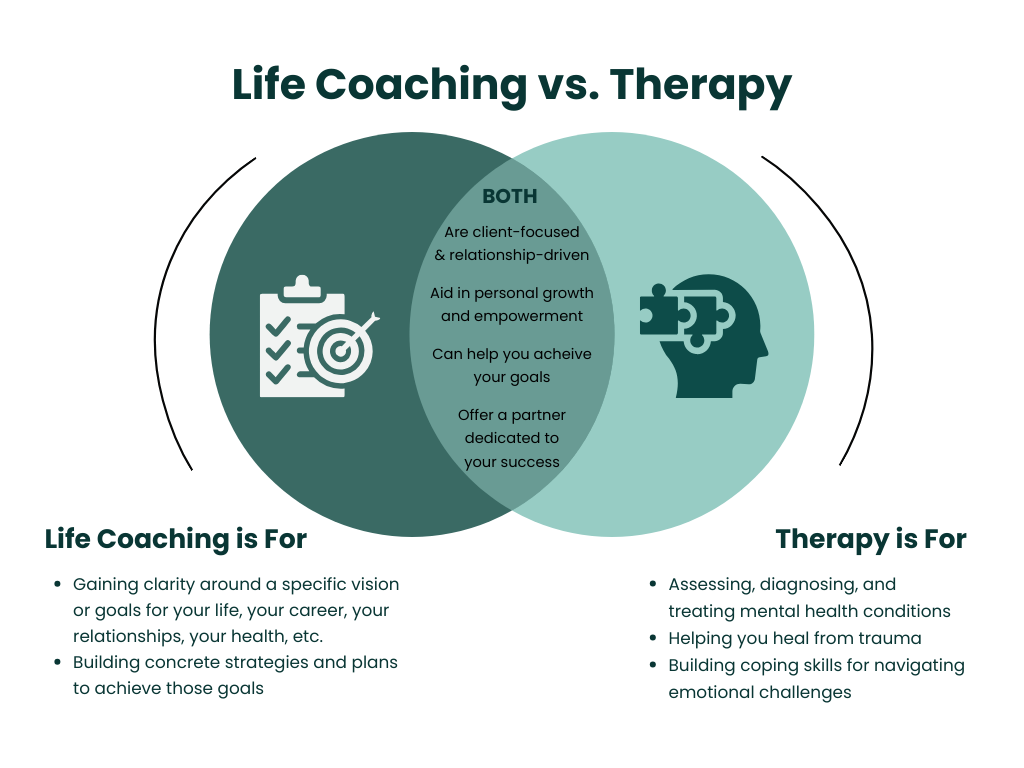
Mark Pines of Open Counseling offers a simple definition of the difference that might help: Therapy is for when you want to feel better. Life Coaching is for when you want to do better.
The below diagram helps to further highlight the similarities and differences between Life Coaching and Therapy.
Other Key Differences
Training:
- A life coach can technically practice without any training, while therapists typically work for up to eight years to obtain the necessary credentials.
- This means that while a therapist can act as a life coach, a life coach cannot legally call themselves a therapist.
Licensing and Regulation:
- Therapists are licensed mental health professionals. They are required to complete a graduate education program, gain a certain number of clinical hours, pass state licensure exams, and participate in continuing education to maintain those licenses.
- While there are certificate programs for coaching, most notably through the ICF, there is currently no standard governing body for the coaching profession.
Reimbursement:
- Because a therapist works with mental health disorders, services are often covered by insurance plans, which adds an extra layer of authorization requirements for providers.
- As coaches are not defined as health care professionals, clients often need to pay out-of-pocket for sessions.
So How Do I Know What’s Right For Me?
Do you have specific, short-term goals in a particular area of your life? Need help organizing your thoughts and working in a purposeful way to achieve the things you want? Looking for accountability and structure?
- A life coach may be what you are looking for.
Are you looking to better stabilize or regulate your emotions? Heal emotional wounds? Build a deeper understanding of your thought patterns and how they drive your actions? Do you have inner blocks or past trauma that is keeping you from realizing your best self?
- A therapist may be right for you.
While Sage is a therapy practice, we often refer to coaching professionals for additional and/or differing support for our clients. Below are two in the Chicago area that we like to recommend:
Ultimately, your choice may come down to something as simple as trust and fit. While coaching may not be as regulated as therapy, there are certainly unethical therapists out there. At their core, both life coaching and therapy are relationship-led, and so it’s important for you to feel comfortable with whoever you choose so that you can work to self-actualize in the most supportive environment possible. So trust your gut and your instincts!
All material provided on this website is for informational purposes only. Direct consultation of a qualified provider should be sought for any specific questions or problems. Use of this website in no way constitutes professional service or advice.