
Coping with the Uncertainty of Life Transitions
Introduction:
Most of us will experience a life transition at some point in our lives. Whether it be moving to a new city, changing careers, starting college, becoming a parent, or navigating loss, these pivotal moments in life bring unique challenges and stress that can greatly impact our mental health and well-being. Despite the unique challenges and stress life transitions bring, it is oftentimes the uncertainty they create that many of us struggle with. As humans, we have a desire for predictability, which brings us a sense of comfort, security, and control. When things are outside of our control and make us feel uncomfortable, we may experience anxiety.
The purpose of this blog is to help you feel more in control during transitional periods of life. Throughout this blog, you will learn about what the circle of control is and the importance of having a routine. By the end of the blog, my goal is for you to feel more confident navigating life transitions when they arise.
Life Transitions: The three phases
Life transitions are pivotal and important changes an individual experiences in their life because it marks the beginning of a new chapter, role, or stage in life. Individuals go through three phases when they experience a life transition: the ending phase, the middle phase, and the beginning phase. The ending phase is characterized by letting go of the past. This phase may be filled with a lot of emotions, especially if this phase was prompted by something outside of your control. The middle phase is like trying to find your feet again. It can be filled with uncertainty, unpredictability, and doubt. The beginning phase is the phase where your new chapter can be embraced. Maybe you found your rhythm, are feeling settled, and overall feeling more at peace.
What is the circle of control:
The circle of control model is a framework that allows us to sort our worries into three categories: 1) things I can control, 2) things I can influence, 3) things I cannot control. The innermost circle is our power center. This circle contains things we have genuine control over, including our attitude, boundaries, daily habits, personal goals, and priorities. The middle circle contains things we can influence, but can not fully control. This includes how others respond to us and relationship dynamics. Lastly, the outer circle is the home for all the anxiety we feel. We can not control anything that goes into this circle. This includes unexpected life events, other people’s choices, and what others think of us.
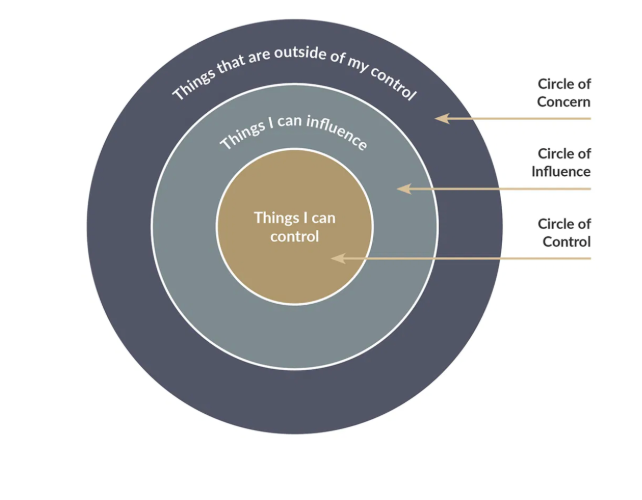
When navigating a life transition, the circle of control can be used as a powerful tool to help us regain control, reduce our anxiety, and feel more grounded. Research shows that individuals who use this model in their own lives are more likely to be resilient in stressful situations. For the purpose of this blog, I want to direct our focus back to the innermost circle: things we can control. Oftentimes when we are in the midst of chaos and uncertainty, we lose sight of the fact that we actually CAN have some control of the situation we are in. I believe one of the best and easiest ways to feel a sense of control, predictability, and comfort is to create a routine.
Why are routines so important?
Daily routines are planned patterns of behaviors that provide us with a sense of security. Routines can reduce stress and mental fatigue while boosting our mental well-being. When our body knows how it will move throughout the day, our brain has less work to do. People who have a daily routine may experience better overall health, improved sleep, less stress and anxiety, and increased productivity.
Tips/Tricks for building a routine:
Have you ever tried a routine that lasted a few days and then you gave up? I’ve been there too. Sometimes we make our routines too rigid, which does not make them sustainable. Routines should be flexible! They are there to provide you with a sense of control and support, not something you strictly have to follow.
Routines will look different for everyone because we each have different wants and needs. When it comes to building a routine, it is important to start small and build your way up. Below are some habits you can incorporate into your day to start building a routine:
1. Find a consistent sleep schedule
If we are getting inconsistent sleep, our energy and mood may feel shifted. Going to bed and waking up at the same time everyday supports circadian rhythm, which helps regulate our mood and energy. It is recommended that adults sleep for 7 to 9 hours per night.
2. Designated physical activity time
Designating a specific time of the day to engage in physical activity is beneficial to our mental well-being. Even if it is just for 10 to 15 minutes, serotonin and dopamine will be released in the brain, improving mood and reducing stress.
3. Meal times
When we are navigating change, we may forget our basic necessities, like eating. Scheduling meals is a great way to ensure the body is getting the nutrients it needs, while also creating that sense of control.
Conclusion:
Navigating life transitions is hard, and the uncertainty and unpredictability that come along with it is a challenge in itself. If you are currently experiencing a life transition, a simple routine may be the one thing that brings you that sense of comfort and security you are longing for. Routines do not have to be rigid, but rather something you can add into your day that is predictable. Finding a consistent sleep time, scheduling meal times, and designating time for physical activity are all great ways to start to feel in control of your day. As you become more comfortable and settled with your routine, you will slowly shift from the middle to beginning phase of your life transition. Remember, when life feels out of control, I encourage you to reflect on what you can control!
Sources:
- Bronaugh, B. (2025). Life transition: Definition, types & how to deal. LifeCycle Transitions.
- How a daily routine can boost your mental health. (2026). In Uclahealth.org. UCLA Health.
- Schaffner, A. K. (2023). Understanding the circles of influence, concern, and control. In PositivePsychology.com.
- Simply Psychology Editorial. (2026). The mental health benefits of daily routine (and how to build one that sticks). In Simplypsychology.com.
- South Hills Counseling & Wellness. (2026). An emotional well being roadmap for navigating major life changes. In South Hills Counseling & Wellness.
All material provided on this website is for informational purposes only. Direct consultation of a qualified provider should be sought for any specific questions or problems. Use of this website in no way constitutes professional service or advice.

.jpg)