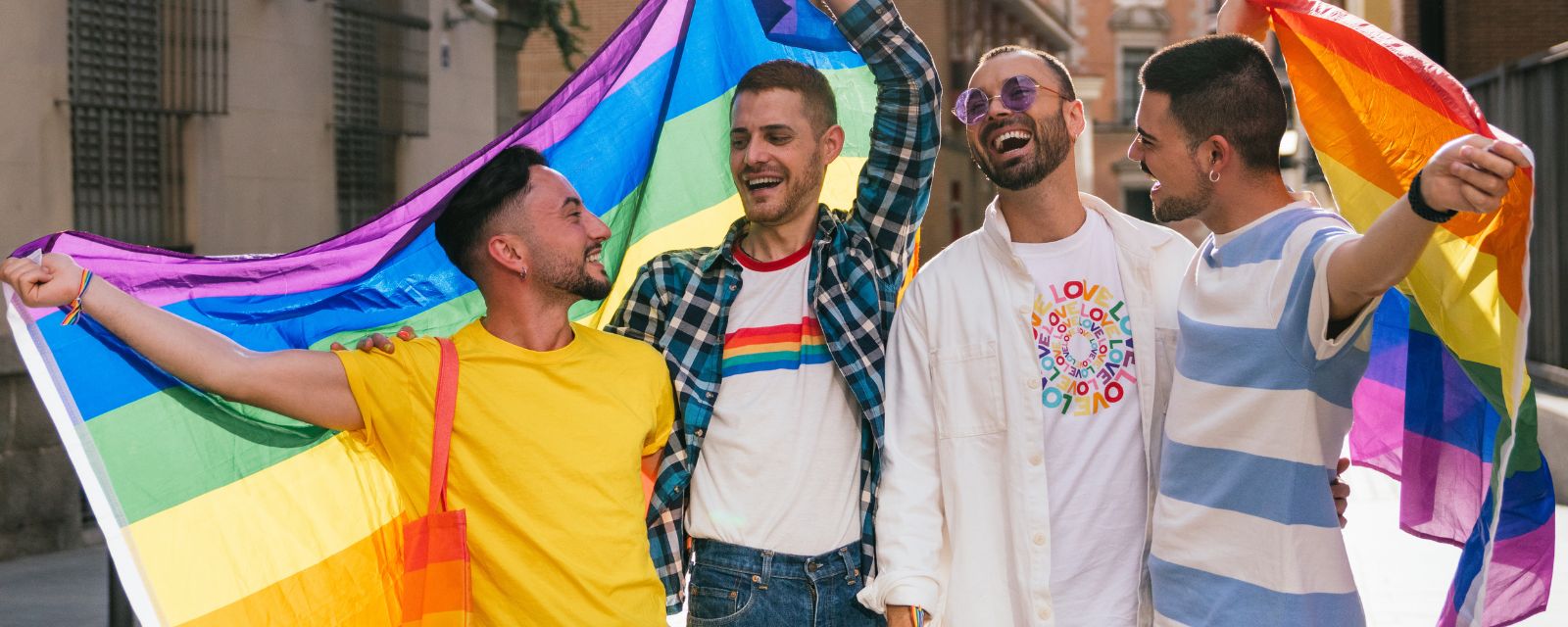
What Queer Liberation Psychology Teaches Us About Pride in 2026
For many queer folks, Pride 2026 feels different than years past. While spaces for celebration and joy still exist, the first few weeks of this month have already brought mixed emotions. Across the country, companies that spent years draping themselves in rainbow flags like Target and Walmart have quietly folded those flags and walked away, citing DEI rollbacks, political climate, and "economic uncertainty."
For many queer people, the reaction to this news feels complicated. For some, it can feel like being abandoned as familiar sponsors disappearing confirms valid fears about safety for LGBTQ+ people in this moment. Some feel vindicated, stating queer joy was never going to come from boardrooms or clever displays of merchandise at a store. Many feel both of these things, leaving queer folks with a familiar question that usually gets revisited around this time of year. How can I celebrate Pride with intentionality this year?
When I work with clients who are trying to make sense of everything, sometimes the best place to start is exploring, what makes you feel like the most liberated version of yourself?
Queer Liberation Psychology
Liberation Psychology is a theoretical framework developed in Latin America in the 1980’s by Psychologist and Jesuit priest Ignacio Martín-Baró. In his work, Martín-Baró posits that the individual is intertwined with the socio-political. Central to Liberation Psychology is the idea of consciousness raising or naming when systems of oppression and injustice are present. These systems can include racism, classism, homophobia, transphobia, religious oppression, and more. From the context of Queer Liberation Psychology, LGBTQ+ people naming the connection between systems of oppression and its direct negative impact on LGBTQ+ mental health is a form of liberation. Queer people as individuals can explicitly acknowledge that individual mental health cannot be divorced from the context of the sociopolitical. In recognizing this in the therapeutic context, we can then begin to identify tools and strategies to embrace authenticity, self-expression, and joy.
Modern Pride celebrations have often been shaped by what corporations find acceptable to permit in public settings, narrowing expressions of queerness and distancing Pride from its roots in the Stonewall movement. Liberation Psychology invites us to reconnect with our history and LGBTQ+ ancestors. In turn, we can receive guidance for reimagining Pride in 2026 beyond the limitations of corporate pride, inviting room for intentionality.
The Roots of Pride
On June 28, 1969, patrons of the Stonewall Inn, many of whom were BIPOC Women, Black and Brown trans women, drag queens, and homeless queer youth, fought back against a police raid in Greenwich Village. At the time of Stonewall, trailblazers like Marsha P. Johnson and Sylvia Rivera weren't marching toward visibility but fighting for their survival. In the year following, commemorations of that moment weren't festivals but were protests and resistance movements. Community members came together to engage in an act of collective defiance and community at a time when being queer came at the risk of losing everything.
The original Pride was a demand and a refusal to disappear. Pride connects with many of the ideas postulated by Queer Liberation Psychology. Pride is about recognizing the impact of systems of oppression on community members at all intersections of identity. Pride is also about shifting attention from individual “resilience” to collective resistance and interdependence. Pride is now both a remembrance of those who fought before, uplifting their voices and experiences with oppression, while remaining a continued call to action. To do the work of building conditions where queer and trans people can live freely, without having to shrink, justify, or translate themselves for safety or belonging.
Understanding Pride through this lens can help us stay grounded in Pride’s original purpose. Once we know what our intentions are, we can then identify tools that can serve us and sustain us in the modern era.
'Queer & Tired’
As we enter the month of June, one common refrain I’ve heard is that of “queer and tired”. While this phrase is a fun way to communicate a collective experience for queer people, it is also an acknowledgment of why Pride is so critical in this moment, especially at a time when there is a rise in anxiety, depression, and suicidal thinking for LGBTQ+ people.
For people across the LGBTQ+ spectrum, the last several years have been a place of sustained activation of our nervous system. Legislative attacks, rollbacks of protections, an increase in violence, and watching healthcare institutions engage in complicity or even worse, silence. This increase in stress can lead to short and long-term impacts on a person’s well-being that affect things such as sleep, cardiovascular health, and digestive health.
It is well documented through research by mental health professionals that queer people experience elevated rates of anxiety, depression, and psychological distress compared to their heterosexual and cisgender peers. From a Liberation Psychology framework, all of this reinforces how individual mental health is intertwined with the sociopolitical.

On Liberation and Freedom
Beyond the act of consciousness raising, Liberation Psychology invites us to engage in the critical work of living life free from fear. I want to take a moment to now offer some tools grounded in Queer Liberation Psychology you can use this Pride season.
1. Radical Restorative Practices
In his original work, Martín-Baró encourages reconnection with our whole selves, which is central to liberatory practices. This can include the physical body, connecting with our faith or spiritual self, or even reconnecting with nature.
Rest and reconnecting with ourselves is a radical act that celebrates self-worth, self-love, and knowing you are worth celebrating just as you are. Rest represents the opportunity to restore what has been depleted and creates space for regulation, reflection, and reconnection beyond the demands of survival. This is one of the often overlooked gifts of Pride and is something that Liberation Psychology lifts up as a way to engage in meaningful resistance. This Pride, I want to offer permission to do less and not perform celebration if celebration doesn't feel honest.
2. Testimonials
One of the most powerful tools Liberation Psychology offers is the idea of testimonials. Testimonials allow community members to explicitly name how systems of oppression have harmed them and limited Queer people from authenticity and self-expression.
Testimonials also offer us a space to name for ourselves times in which we have felt liberated, whether that is from memory or even imagined spaces. Dr. Thema Bryant encourages us to think as specifically as we can, exploring memories or experiences in detail, even down to physical sensations.
Testimonials also offer space to reflect on ways in which we are liberated in the present and ask what it is that I want to do with this day and moment that is presented to me.
3. Community
Queer Liberation Psychology also acknowledges the critical value community brings. Research has found that LGBTQ+ individuals who experience a stronger sense of connection and belonging within the queer community report better mental health outcomes.
In Queer Liberation Psychology, community is viewed as a space where people can gain empowerment and wisdom from others. Time in community offers space to remember those who have been central to the Pride movement from the very beginning, specifically BIPOC women and those from the Transgender community. In community, we are invited to lift up our ancestors from the past who were on the margins, as well as those on the margins in the present, as none of us are free until all of us are free.
4. Action
Liberation Psychology is not just something one does through observation, but is a gateway to engaging in proactive steps, civic action, participating in resistance, and throwing sand into the gears of systems of oppression. Action can come in a multitude of ways, including filing a complaint at work, writing a letter to a legislator, engaging in community advocacy, and giving of time or other resources.
Queer Liberation Psychology challenges us to recognize that even in the most trying of times, we are not powerless. This moment in history is a backlash against progress that has been made by prior generations, but this backlash is not the first of its kind. Just like our queer ancestors before us, there are things we can engage in today to continue in the march for progress.
Concluding Thoughts
Pride emerged from communities of queer people who gathered together in the face of exclusion and discrimination, demanding the right to live authentically. Its roots are found in resistance, and at its heart, Pride is about creating the conditions necessary for people to thrive.
A Queer Liberation Psychology reminds us of the very real impact of the sociopolitical environment on LGBTQ+ well-being. However, that liberation is not just the absence of discrimination. It is the presence of belonging, nurturance, joy, dignity, and reconnection that helps sustain us everyday through out the year. It is the ability to continue moving toward authenticity and dignity when systems attempt to tear individuals down. In a world where many queer people continue to navigate stress, uncertainty, and exclusion, Pride offers something profoundly healing that goes to a biological level.
More than fifty years after Stonewall, Pride continues to serve as a movement that continues to empower each generation. It is a declaration that LGBTQ+ people deserve dignity, safety, and belonging, and it is an invitation to imagine a future where liberation is measured not only by what people are free from, but by what they are free to experience.
Resources:
- A History of the Pride Movement & Stonewall
- LGBTQ+ Mental Health and the Role of Minority Stress
- The Real Mental Health Benefits of Celebrating Pride
- LGBTQ+ young people face large increases in depression, anxiety, and suicidal thinking
- The Homecoming Podcast with Dr. Thema Bryant Episode 188: Liberation Psychology
- Liberating Psychotherapy: Liberation Psychology and Psychotherapy with LGBT Clients By Glenda Russell & Janis Bohan (2008)
All material provided on this website is for informational purposes only. Direct consultation of a qualified provider should be sought for any specific questions or problems. Use of this website in no way constitutes professional service or advice.