
What Are Cognitive Distortions? 9 Patterns That Shape How You Think
Introduction:
“My friend didn’t answer my text right away, so they’re probably mad at me.”
“I felt really awkward in that conversation. I’m always so awkward.”
“I had a bad day at work yesterday, so today will also be a bad day.”
If any of these thoughts feel familiar, then you may have experienced what is called a cognitive distortion.
Cognitive distortions are irrational and negative thought patterns. These distortions shape how we act, feel, and view the world. Cognitive distortions are often not based on facts, leading those who experience these distortions to have a skewed reality of how things really are. The purpose of this blog is to share how cognitive distortions develop, the most common types of cognitive distortions, and what you can do to manage this type of unhelpful thinking.
Development of cognitive distortions
The way we think is shaped and influenced by our life experiences. The way we view ourselves and the world around us comes from the experiences we have with our family, community, school, and even culture. Cognitive distortions typically develop during one’s early years as a child. We may hear messages or statements from adults, peers, and even through the media. Negative thoughts can lead to low self-esteem, lack of motivation, depression, and unhealthy coping behaviors like avoidance.
Common types of cognitive distortions
1. Personalization
This type of cognitive distortion involves believing that you are responsible for something that is outside of your control. You blame yourself for how events unfold and feel an immense sense of guilt, even though there are many other factors and possibilities as to why something is the way it is.
Example: “My friend cancelled our plans last minute. I must have done something to upset her.”
2. Should, Must, and Ought Statements
When we use the words “should”, “must”, or “ought”, we are setting an expectation and standard for ourselves. In today’s society, it can be very easy to fall into a cycle of comparing our life to the lives of those around us, with social media playing a huge role in this. We may feel like we have to meet these expectations and standards to succeed, and we measure our worth based on these standards.
Example: “All of my friends my age are getting married and buying houses. I should be so much further in life at my age.”
3. Magnification or Minimization
Magnification occurs when we perceive something as more significant than what it is. On the other hand, minimization occurs when we perceive something as less important than what it is.
Example (magnification): You made a small mistake at work and now believe you will get fired.
Example (minimization): Believing you got a good grade because of luck, not because you studied hard.
4. Mind Reading and Fortune Telling
Mind reading occurs when we interpret other people's thoughts and beliefs without evidence. We assume that we know what others think or believe, even though there is no evidence for those thoughts or beliefs. Fortune telling is when we expect or predict how an event will unfold. This can occur in an attempt to avoid something difficult.
Example (mind reading): “They didn’t invite me to dinner. They probably hate me.”
Example (fortune telling): “I’m going to fail the test anyway, so there’s no point in studying.”
5. Disqualifying the Positive
This occurs when we invalidate the positives of a situation and focus only on the negative aspects.
Example: You receive many praises during your yearly evaluation, but focus on the single critique you received.
6. All-or-Nothing Thinking
This type of cognitive distortion involves thinking in absolutes, such as all good or all bad or perfection or complete failure. Key words include “always”, “never”, or “every.” There is no middle ground or gray area for individuals who experience this type of thinking.
Example: “I never do a good job on anything.”
7. Emotional Reasoning
Emotional reasoning is when we assume that emotions reflect the reality of a situation. Instead of focusing on the facts of a situation, we let our emotions take control.
Example: “I feel like a bad daughter, therefore I am a bad daughter.”
8. Overgeneralization
When we make broad interpretations from a single or few events, we are overgeneralizing. We assume that there will be a pattern after a single or few negative events.
Example: “I did not get the job. Every job will reject me.”
9. Magical Thinking
This occurs when we believe that our thoughts, emotions, or actions influence unrelated situations or world events.
Example: “I hoped he would get payback, so it is my fault he got in a car accident.”
Managing Cognitive Distortions
Navigating cognitive distortions can feel overwhelming and challenging. However, there are strategies that can make it feel less daunting. Below I will discuss two strategies that are helpful in getting started: awareness and restructuring.
Awareness
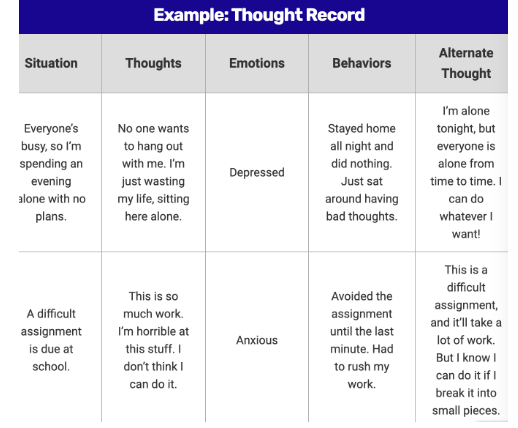
Cognitive distortions are automatic thoughts that influence our emotions which influence how we behave. Because they are automatic thoughts, we may fail to notice them even though they greatly impact how we feel. It may be helpful to write down your thoughts as they appear to recognize triggers and patterns. A helpful tool I recommend to clients is a thought record. This tool allows you to identify what triggered a negative thought, how it made you feel, and what you did as a result of that thought. It then asks you to replace the negative thought with a more positive, rational thought.
Restructuring your thoughts
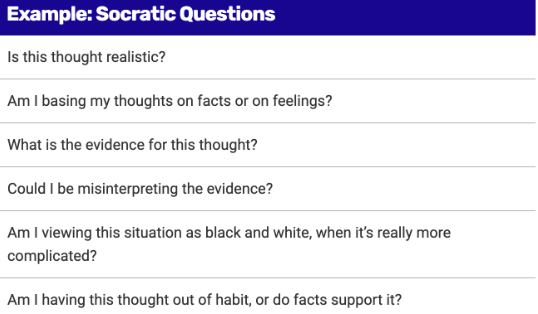
We believe cognitive distortions even though they are not true. In order to stop the cycle, we should challenge our thoughts. A technique that is useful is called socratic questioning. Once you have identified your unhelpful thought, let’s assess it before proceeding. Socratic questioning involves examining, challenging, and changing an irrational thought. The goal of this technique is to create a more accurate and balanced thought.
Conclusion
Once we are able to identify our triggers and notice our thought patterns, we can begin to take back control of our thoughts. By reframing our thoughts, we can approach challenges, problems, and feelings with a healthier, more helpful perspective. Restructuring the way your brain thinks is a challenging process, so I encourage you to give yourself patience and grace. Remember, you got this!
Sources:
- Skyland Trail. 10 Common types of cognitive distortions
- Harvard Health Publishing. How to recognize and tame your cognitive distortions
- HelpGuide. Cognitive distortions: Put an end to negative thinking
- Psych Central. 15 Cognitive distortions to blame for your negative thinking
- Rnic, K., Dozois, D. J. A., & Martin, R. A. (2016). Cognitive distortions, humor styles, and depression. Europe’s Journal of Psychology, 12(3), 348–362.
- Therapist Aid. Cognitive restructuring (guide)
All material provided on this website is for informational purposes only. Direct consultation of a qualified provider should be sought for any specific questions or problems. Use of this website in no way constitutes professional service or advice.
.jpg)